My Twitter Feed

Apr 17, 2010

Deadlifting 101


Besides squats, deadlifts are far and away the most complete exercise you can do. In the weight-lifting realm deadlifts are king. If you want to shape a powerful physique, deadlifting is essential in any routine.


What are the benefits of deadlifts and why are they so great?

  • They build forearm and grip strength
  • They improve posture
  • They build total body strength.
  • They work many muscle groups in one simple movement: the calves, quads, hamstrings, butt, arms, core, lower/middle/upper back, traps, and shoulders.
  • They shape all parts of a hard, strong core (obliques, upper/lower abdominals, transverse abdominis or "deep/inner" abdominals)
  • They blast the hamstrings and butt. They're great for getting rid of a flat ass.
  • They increase the release of muscle building hormones such as HGH and testosterone.
  • They burn a lot of calories, especially calories from fat.
  • They are extremely safe when done with correct form. Unlike squats or the bench press, you don't risk being pinned under a heavy weight. If your forearms or back give out you can bail and drop the weight safely.
  • They prevent injury. They strengthen the back and prevent back pain.
  • They have practical real life application. Ever lift a heavy TV or box off the floor? You're deadlifting. Start deadlifting and impress your significant other the next time you have to move something heavy.
  • They're a high-intensity cardiovascular workout. They work your heart and help raise VO2Max-your body's ability to transport and use oxygen during exercise (its an indicator of cardiovascular endurance and fitness).
  • They require very limited equipment. All you need is a barbell and some plates. Dumbbells work too. 
  • You'll look powerful when you do them right. 
  • They're not just for guys! Girls looking to work on their legs and butt should deadlift.
 The benefits go on, and on, and on...

So...How do I do a deadlift?

In order to take advantage of the many benefits deadlifts offer proper form is critical. If you're new to deadlifting it's a must that you start with a light weight until you learn how to do them correctly. Every day in the gym I see people deadlifting completely wrong, and it pains me...they're wasting all that effort on something that will wield less than optimal results and probably cause serious injury. Take the time to learn the form, you'll see better results and be better for it.
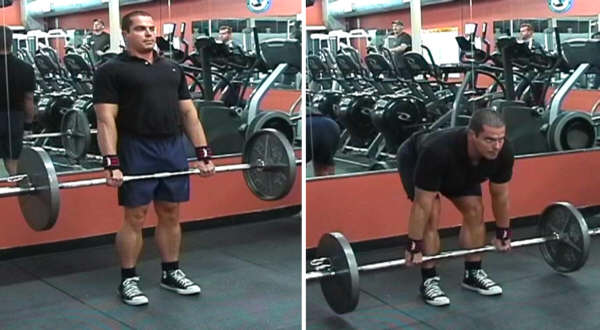
  1. Stand with your feet shoulder-width apart in front of a barbell, squat down so that your thighs are slightly higher than parallel to the floor, and grip the barbell so that the inside of your forearms touch the outside of your thighs. The bar should be rolled up against your shins.
  2. Tighten your core and keep your back in neutral alignment (straight) throughout the movement. NEVER, NEVER, EVER arch your back. If you arch your back you WILL put unnecessary stress on it and cause injury. 
  3. Hold the bar firmly with an overhand grip (palms facing in). Start the lift by driving your heels and hamstrings into the ground, while simultaneously moving your torso into the standing position as you exhale. Breathing is really important--exhale as your lift, inhale on the way down. As you ascend with your legs and hips make sure to simultaneously ascend with your back and shoulders. Deadlifts have one fluid motion, not two. DO NOT make the mistake of bringing the weight off the ground with only your legs and then snapping your back backwards--that's a great way to get hurt.
  4. Once the weight is up and your back is straight, stick your chest out, squeeze your shoulder blades together, and lean back slightly. Hold that position for 1 second and return the weight to the ground by bending at the knees and simultaneously leaning your torso forward. Keep your back straight during the descent
  5. After each rep the weight should rest on the floor for 1 second before you start your next lift. Re-grip if necessary.
  6. Practice makes perfect: Deadlift with a light weight, get the form down, and eventually progress to heavier weights. As you start adding weight your forearm strength may start to lag behind your back strength. You can either use wrist wraps, or an alternating grip (1 palm facing in, 1 palm facing out) to help with this problem. I advise avoiding wrist wraps for as long as possible because they take away the grip/forearm element of the lift.


    Other Variations
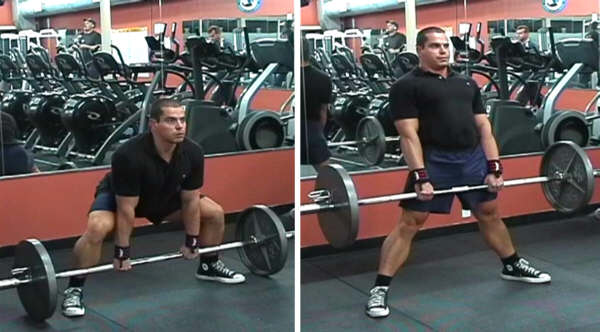
    1. Dumbbell Deadlifts: Same motion as a barbell deadlift, just with 2 dumbbells.
    2. Sumo Deadlifts (top picture): Start with a very wide stance, about twice as wide as a barbell deadlift. This puts much more stress on your quads, and takes a lot of stress off of your lower back. This is typically used by olympic power lifters who are lifting weight upwards of 1000 lbs. http://www.exrx.net/WeightExercises/ErectorSpinae/BBSumoDeadlift.html
    3. Romanian Deadlifts (A.K.A. Stiff-Legged Barbell/Dumbbell Deadlifts, bottom picture): This is the best exercise for developing hamstring and butt strength/size. I advise doing them as well as traditional deadlifts. Stand up straight, bend at your hips, and grab the barbell. Your knees should be slightly bent. Grab the weight, keep your back straight (no arching!), and drive it upwards using your hamstrings, butt, back, and shoulders. On the descent lower the weight by bending at the hips and slightly bending your knees. http://www.exrx.net/WeightExercises/OlympicLifts/RomanianDeadlift.html
     

    Apr 16, 2010

    Never Walk Into a Supplement Shop Without Knowing What You Want


    Somehow the supplement business has become a $23 billion industry. Why? Partly because some supplements do work, but also because uneducated consumers get tricked and persuaded by VERY convincing marketers. Walking in cold and relying on product labels is a supplement marketers dream and a huge pitfall for consumers. There are literally 1000's of different supplements, all with the promise of doing something miraculous for your body. But do you really know what these products are doing? If you go into a supplement store and read the labels you'll see things like 1000% accelerated muscle growth, enhanced protein synthesis, godlike strength, body fat incineration, skin-tearing muscle pumps...quite frankly, they all sound fantastic. Marketers can make these claims all they want, but the reality is that most products won't do anything close to what they advertise. While it's true that some supplements work really well and do what they advertise, I'd estimate that 80% are complete crap and are nothing more than a blend of sugar and some other insignificant ingredients. Save yourself some time and money. If you're interested in taking supplements familiarize yourself with the different types and brands and do some research or ask a friend. ALWAYS figure out what works and what you want beforehand. Walk into the store with the intention of buying what you want and walk out with only what you came for.

    Apr 14, 2010

    HFCS and the Obesity Epidemic

    Here's yet another article linking HFCS to obesity, especially around the abdominal area. This stuff is nasty, avoid it so you don't end up like this.


     A sweet problem: Princeton researchers find that high-fructose corn syrup prompts considerably more weight gain


    "A Princeton University research team has demonstrated that all sweeteners are not equal when it comes to weight gain: Rats with access to high-fructose corn syrup gained significantly more weight than those with access to table sugar, even when their overall caloric intake was the same. 

    In addition to causing significant weight gain in lab animals, long-term consumption of high-fructose corn syrup also led to abnormal increases in body fat, especially in the abdomen, and a rise in circulating blood fats called triglycerides. The researchers say the work sheds light on the factors contributing to obesity trends in the United States.

    "Some people have claimed that high-fructose corn syrup is no different than other sweeteners when it comes to weight gain and obesity, but our results make it clear that this just isn't true, at least under the conditions of our tests," said psychology professor Bart Hoebel, who specializes in the neuroscience of appetite, weight and sugar addiction. "When rats are drinking high-fructose corn syrup at levels well below those in soda pop, they're becoming obese -- every single one, across the board. Even when rats are fed a high-fat diet, you don't see this; they don't all gain extra weight."

    Hoebel lab
    A Princeton University research team, including (from left) undergraduate Elyse Powell, psychology professor Bart Hoebel, visiting research associate Nicole Avena and graduate student Miriam Bocarsly, has demonstrated that rats with access to high-fructose corn syrup -- a sweetener found in many popular sodas -- gain significantly more weight than those with access to water sweetened with table sugar, even when they consume the same number of calories. The work may have important implications for understanding obesity trends in the United States. (Photo: Denise Applewhite) Photos for news media
    In results published online Feb. 26 by the journal Pharmacology, Biochemistry and Behavior, the researchers from the Department of Psychology and the Princeton Neuroscience Institute reported on two experiments investigating the link between the consumption of high-fructose corn syrup and obesity.

    The first study showed that male rats given water sweetened with high-fructose corn syrup in addition to a standard diet of rat chow gained much more weight than male rats that received water sweetened with table sugar, or sucrose, in conjunction with the standard diet. The concentration of sugar in the sucrose solution was the same as is found in some commercial soft drinks, while the high-fructose corn syrup solution was half as concentrated as most sodas.

    The second experiment -- the first long-term study of the effects of high-fructose corn syrup consumption on obesity in lab animals -- monitored weight gain, body fat and triglyceride levels in rats with access to high-fructose corn syrup over a period of six months. Compared to animals eating only rat chow, rats on a diet rich in high-fructose corn syrup showed characteristic signs of a dangerous condition known in humans as the metabolic syndrome, including abnormal weight gain, significant increases in circulating triglycerides and augmented fat deposition, especially visceral fat around the belly. Male rats in particular ballooned in size: Animals with access to high-fructose corn syrup gained 48 percent more weight than those eating a normal diet.

    "These rats aren't just getting fat; they're demonstrating characteristics of obesity, including substantial increases in abdominal fat and circulating triglycerides," said Princeton graduate student Miriam Bocarsly. "In humans, these same characteristics are known risk factors for high blood pressure, coronary artery disease, cancer and diabetes." In addition to Hoebel and Bocarsly, the research team included Princeton undergraduate Elyse Powell and visiting research associate Nicole Avena, who was affiliated with Rockefeller University during the study and is now on the faculty at the University of Florida. The Princeton researchers note that they do not know yet why high-fructose corn syrup fed to rats in their study generated more triglycerides, and more body fat that resulted in obesity.

    Hoebel lab
    When male rats were given water sweetened with high-fructose corn syrup in addition to a standard diet of rat chow, the animals gained much more weight than male rats that received water sweetened with table sugar, or sucrose, along with the standard diet. The concentration of sugar in the sucrose solution was the same as is found in some commercial soft drinks, while the high-fructose corn syrup solution was half as concentrated as most sodas, including the orange soft drink shown here. (Photo: Denise Applewhite)
    High-fructose corn syrup and sucrose are both compounds that contain the simple sugars fructose and glucose, but there at least two clear differences between them. First, sucrose is composed of equal amounts of the two simple sugars -- it is 50 percent fructose and 50 percent glucose -- but the typical high-fructose corn syrup used in this study features a slightly imbalanced ratio, containing 55 percent fructose and 42 percent glucose. Larger sugar molecules called higher saccharides make up the remaining 3 percent of the sweetener. Second, as a result of the manufacturing process for high-fructose corn syrup, the fructose molecules in the sweetener are free and unbound, ready for absorption and utilization. In contrast, every fructose molecule in sucrose that comes from cane sugar or beet sugar is bound to a corresponding glucose molecule and must go through an extra metabolic step before it can be utilized.

    This creates a fascinating puzzle. The rats in the Princeton study became obese by drinking high-fructose corn syrup, but not by drinking sucrose. The critical differences in appetite, metabolism and gene expression that underlie this phenomenon are yet to be discovered, but may relate to the fact that excess fructose is being metabolized to produce fat, while glucose is largely being processed for energy or stored as a carbohydrate, called glycogen, in the liver and muscles.

    In the 40 years since the introduction of high-fructose corn syrup as a cost-effective sweetener in the American diet, rates of obesity in the U.S. have skyrocketed, according to the Centers for Disease Control and Prevention. In 1970, around 15 percent of the U.S. population met the definition for obesity; today, roughly one-third of the American adults are considered obese, the CDC reported. High-fructose corn syrup is found in a wide range of foods and beverages, including fruit juice, soda, cereal, bread, yogurt, ketchup and mayonnaise. On average, Americans consume 60 pounds of the sweetener per person every year.

    "Our findings lend support to the theory that the excessive consumption of high-fructose corn syrup found in many beverages may be an important factor in the obesity epidemic," Avena said.

    The new research complements previous work led by Hoebel and Avena demonstrating that sucrose can be addictive, having effects on the brain similar to some drugs of abuse. 

    In the future, the team intends to explore how the animals respond to the consumption of high-fructose corn syrup in conjunction with a high-fat diet -- the equivalent of a typical fast-food meal containing a hamburger, fries and soda -- and whether excessive high-fructose corn syrup consumption contributes to the diseases associated with obesity. Another step will be to study how fructose affects brain function in the control of appetite."
    The research was supported by the U.S. Public Health Service.

    Apr 13, 2010

    Swiss Ball Total Core Workout

    Here's a great workout that'll really blast your core from a number of angles and hit every part. The best part is all you need is a swiss ball! Working out with a swiss ball is a great way to take stress off of your lower back and neck, and directly target your abdominal region. The swiss ball also requires you to stabilize your core throughout the movement in order to stay balanced. This added stabilization is a great way to train your entire core with each movement as opposed to only the target region.

    Rest for only 20 seconds between sets to keep the intensity up! This will not only help burn more calories, but it will keep the stress on your abdominals continuously throughout the workout.

    Swiss Ball Ab Crunch - 3 sets, 15 reps. Your lower back should be in contact with the ball, curved against the top. Movement should be slow and deliberate. Make sure to fully extend your back and abs at the bottom of the motion and fully squeeze your abs for 1 second at the top. Once your abs get stronger and this gets too easy you can either hold a medicine ball/weight plate behind your head or increase the amount of reps. This should really tire your abs out if you do them slowly and fully contract at the top of the movement.


        Swiss Ball Jackknife - 2 Sets, 15 reps. Start with the top of your feet/shins on the top of the ball and your upper body in pushup position. Tighten your abs, keep your upper body steady, and pull the ball into your chest. Hold it for .5 second and roll the ball back out.


        Swiss Ball Plank - 2 Sets, 60 seconds. Place your forearms on the top of a swiss ball and straighten your legs as far as they can go. Tighten your core, balance the swiss ball, and hold that position for 60 seconds. If you can't hold it for 60 seconds hold the position for as long as possible. With each successive workout you should aim to beat your best time. Once 60 seconds becomes too easy progress the hold to 1m 15s, 1m 30s, 2m etc.

        Swiss Ball Twisting Crunch - 1 set, 12 reps pet side (24 total) - This is very similar to the swiss ball ab crunch, but it's tailored to hit the obliques. Crunch up and bring your left elbow across your body, return to the starting position and repeat by bringing your right elbow across your body. Repeat for the full set.


        Swiss Ball Hip Raise - 1 set, 20 reps - Start with your back flat against the ground and the back of your heels on top of the swiss ball. Dig your heels into the ball and push your pelvis upward until your body forms a straight line at about a 30 degree angle. Finally push your middle back off of the ground and your knees into the air. Return to the starting position and repeat.


        Swiss Ball Back Extension - 1 set, 15 reps - Lie face down with your stomach stretched out across a swiss ball. Raise your back up off the fall as far as it can go, hold for 1s, and return to the starting position.


        Apr 4, 2010

        Is Stress Killing You?

        Check out these two articles about the serious negative impact that stress can have on health and weight. If you're someone who stresses chronically over work or school these are must reads.

        http://www.livescience.com/health/061122_job_stress.html

        http://www.msnbc.msn.com/id/36102036/ns/health-diet_and_nutrition/


        Happy Easter!

        Free Daily Deals on Fitness Stuff!