My Twitter Feed
Showing posts with label News. Show all posts
Aug 16, 2011
Say WHAT!? Each Hour of TV You Watch Shortens Your Life By...
22 minutes!
Researchers in Australia recently conducted a study on 11,000 adults to get to the bottom of just how horrible TV-watching really is for your health. Well...I didn't really see this coming, but the results were pretty shocking. The researchers found that Australian's 25+ collectively watched ~9.8 BILLION hours of TV since 2008, which equated to a loss of 286,000 hours of life--or about 22 minutes/hour of TV watched.
Wow...That's pretty incredible. Thinking about it, you'd have to watch ~23,890 hours to cut 1 year off of your life, or ~65.5 hours to cut 1 day off of your life. Well then, thinking to myself...I've already lost a few months of my life.
Although I do question the validity of the study and their assumption that the loss of years of life is directly caused by TV watching (also, what number do you base a "full life" off of?), there's no doubt that living a sedentary lifestyle is absolutely one of the worst things you can do to your body. The one-two punch of overeating and sitting still is a pretty deadly combo, and a really easy way to develop a nasty case of obesity or heart disease.
So stay active, eat well, and turn off the tube...
For the full story check out http://www.cbsnews.com/8301-504763_162-20093072-10391704.html
Mar 10, 2011
Jonah Hill Loses a TON of Weight for '21 Jump Street' (Pics)
WOW, Jonah Hill lost a ton of weight...he looks totally different, almost scary.

Jonah Hill recently lost 30 pounds prepping for his role in '21 Jump Street,' a comedy/action film remake of the TV series--a drastic change from his plump, roundness in Superbad/Get Him to the Greek. Looks like he took a little advice from Seth Rogen...
Before:
After:

Mar 7, 2011
Gary Taubes Takes on Dr. Oz , What's the Best Diet?
Taubes' school of dieting is based on a few principles, most notably the ideas that:
- energy expenditure, exercise, and the amount of calories you take in don't mean anything
- fat gain/loss is entirely predicated on keeping insulin levels as low as possible
- there shouldn't be any carbs in the diet other than green leafy vegetables, and the majority of the diet should be comprised of foods high in saturated fat (e.g. bacon, lard, fatty steak)
I agree with Taubes that controlling insulin is a HUGE factor for fat manipulation, but his whole approach is so fundamentally wrong on a number of levels. First, although I do whole-heartedly agree that the notion of calories in vs. calories out (we'll call it CICO) is relied on way too heavily by dieters--and realistically is only one of the many factors that control fat gain/loss--the fact that he totally disregards CICO/energy expenditure is ridiculous. I don't care how low your insulin is, if you're overeating based on your body's caloric needs and low levels of activity, you will get fat. You couldn't possibly try to convince me that if I ate 10,000 calories per day, albeit all low insulinogenic foods, I wouldn't get fat...I'd say you're clinically insane.
Next, cutting out carbs altogether isn't sustainable and it isn't healthy...look at Atkins. The body and mind need energy to function and perform well on a day-to-day basis--that energy comes primarily from carbs. Cut out refined/simple carbs altogether, but complex carbs and fruit are essential to a healthy lifestyle. It's just not practical or smart to stop eating carbs--your diet would be devoid of so many vital vitamins and minerals, not to mention fiber. I eat plenty of complex, slow digesting carbs and I seem to be doing just fine for myself.
Also, his theory that saturated fat doesn't impact health is completely wrong and has about a google's worth of scientific studies/published research to refute his claim. Everything he says about cholesterol in Part 3 is so idiotic and ludacris...it's complete BS. I agree that total cholesterol levels don't mean much, but the notion that LDL cholesterol doesn't mean anything is absurd. There's also something to be said for the fact that he has no clue at all about what his cholesterol levels are and doesn't want them checked...seriously!? How can you claim something works when you have no proof yourself. Just my 2 cents.
Check out the interviews, they're really interesting and worth watching:
Part 1: http://www.doctoroz.com/videos/man-who-thinks-everything-dr-oz-says-wrong-pt-1
Part 2: http://www.doctoroz.com/videos/man-who-thinks-everything-dr-oz-says-wrong-pt-2
Part 3: http://www.doctoroz.com/videos/man-who-thinks-everything-dr-oz-says-wrong-pt-3
What's your view? Do you agree with me or Taubes, or somewhere else on the dietary spectrum?
Jan 24, 2011
Yum...Taco Bell Meat Contains Only 35% Beef, 57% Fat
Taco Bell was recently sued by an Alabama law firm for "falsely advertising" that its products contain seasoned beef. According to the USDA, taco filling has to contain at least 40% fresh meat to be legally marketed as beef...Taco Bell's meat only contains 35% beef, short of the requirement. What's even worse is that 57% of that beef is fat. The next time you go to the grocery store check the meat section, the lowest protein-fat ratio you'll find is probably something close to 65% protein-35% fat or 70% protein-30% fat...but 57% fat, really!?!? Yuck. So if only 35% of Taco Bell's meat is actually beef, what's in the other 65%? Stuff like isolated oat product, maltodextrin, soy lecithin, autolyzed yeast extract, modified corn starch, anti-dusting agent, sodium phosphate and seasonings. Basically artificial food additives, preservatives, and chemicals. If you're opting for fast food Mexican, at least have some regard for your body and go for Chipotle or Qdoba...they have real beef. You'll save your stomach some misery and torment.
You can find the full story at WTOL11 and Yahoo! News.
Oct 3, 2010
Do You Know What's In Your Chicken Nuggets?
I've always been anti-fast food but I think this picture probably takes that hatred to an all new level. Any idea what that pink sludge is? It's what makes up the processed chicken products they sell at McDonalds and BK (think Chicken McNuggets).
I think my stomach is actually getting more upset the longer I stare at this picture.
I don't get how this stuff makes its way into our mouthes. Get this, it has so much bacteria that they actually have to wash it with ammonia! That's what's in clorox or whatever else you clean your toilet with. I'm pretty sure it has to be toxic. To make it worst they artificially flavor and color it so that it somewhat resembles food. Where the hell is the FDA? If it somehow passes health standards that's just ridiculous.
Remember that picture the next time you think about getting Chicken McNuggets. Please god...order something else. Anything but the pink pudding.
You can check out the original story here.
Jul 27, 2010
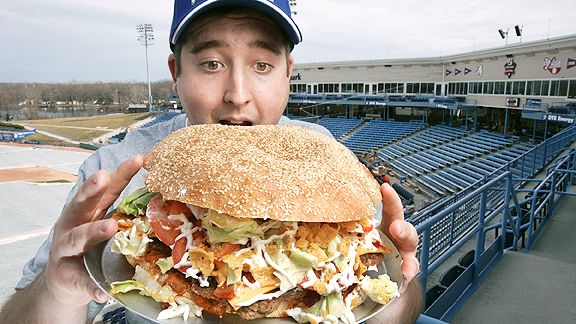
ESPN Outside The Lines Reveals Extremely Unsafe Stadium Food
- Yankee Stadium- 48% of vendors were in violation of health standards. Five hot dogs registered 91 degrees in a hot-holding unit when they were supposed to be no cooler than 140 (aka raw). Inspectors also had a vendor dump a bottle of Chivas Regal whiskey containing dead fruit flies.
- Madison Square Garden- 61% of vendors were in violation of health standards. At one stand, inspectors found "53 mouse excreta" (38 on top of a metal box underneath the cash registers in the front food-prep/service area and 15 on top of a carbonated-beverage dispensing unit.)
- Sun Life Stadium- 93% of vendors were in violation of health standards. In June 2009, an employee complained anonymously that small insects and other debris were blended into frozen alcoholic beverages at a stand where equipment wasn't being cleaned. When inspectors checked, they issued a critical violation for a buildup of slime inside the frozen drinks machine.
Apr 27, 2010
Bucks Mascot Dunks Off 20 Foot Ladder
Check out this ridiculous dunk by the Milwaukee Buck's mascot. He's pretty crazy athletic, especially in that costume.
Apr 14, 2010
HFCS and the Obesity Epidemic
Here's yet another article linking HFCS to obesity, especially around the abdominal area. This stuff is nasty, avoid it so you don't end up like this.
A sweet problem: Princeton researchers find that high-fructose corn syrup prompts considerably more weight gain
Posted March 22, 2010; 10:00 a.m.
by Hilary Parker
"A Princeton University research team has demonstrated that all sweeteners are not equal when it comes to weight gain: Rats with access to high-fructose corn syrup gained significantly more weight than those with access to table sugar, even when their overall caloric intake was the same.In addition to causing significant weight gain in lab animals, long-term consumption of high-fructose corn syrup also led to abnormal increases in body fat, especially in the abdomen, and a rise in circulating blood fats called triglycerides. The researchers say the work sheds light on the factors contributing to obesity trends in the United States.
"Some people have claimed that high-fructose corn syrup is no different than other sweeteners when it comes to weight gain and obesity, but our results make it clear that this just isn't true, at least under the conditions of our tests," said psychology professor Bart Hoebel, who specializes in the neuroscience of appetite, weight and sugar addiction. "When rats are drinking high-fructose corn syrup at levels well below those in soda pop, they're becoming obese -- every single one, across the board. Even when rats are fed a high-fat diet, you don't see this; they don't all gain extra weight."
A Princeton University research team, including (from left) undergraduate Elyse Powell, psychology professor Bart Hoebel, visiting research associate Nicole Avena and graduate student Miriam Bocarsly, has demonstrated that rats with access to high-fructose corn syrup -- a sweetener found in many popular sodas -- gain significantly more weight than those with access to water sweetened with table sugar, even when they consume the same number of calories. The work may have important implications for understanding obesity trends in the United States. (Photo: Denise Applewhite) Photos for news media
The first study showed that male rats given water sweetened with high-fructose corn syrup in addition to a standard diet of rat chow gained much more weight than male rats that received water sweetened with table sugar, or sucrose, in conjunction with the standard diet. The concentration of sugar in the sucrose solution was the same as is found in some commercial soft drinks, while the high-fructose corn syrup solution was half as concentrated as most sodas.
The second experiment -- the first long-term study of the effects of high-fructose corn syrup consumption on obesity in lab animals -- monitored weight gain, body fat and triglyceride levels in rats with access to high-fructose corn syrup over a period of six months. Compared to animals eating only rat chow, rats on a diet rich in high-fructose corn syrup showed characteristic signs of a dangerous condition known in humans as the metabolic syndrome, including abnormal weight gain, significant increases in circulating triglycerides and augmented fat deposition, especially visceral fat around the belly. Male rats in particular ballooned in size: Animals with access to high-fructose corn syrup gained 48 percent more weight than those eating a normal diet.
"These rats aren't just getting fat; they're demonstrating characteristics of obesity, including substantial increases in abdominal fat and circulating triglycerides," said Princeton graduate student Miriam Bocarsly. "In humans, these same characteristics are known risk factors for high blood pressure, coronary artery disease, cancer and diabetes." In addition to Hoebel and Bocarsly, the research team included Princeton undergraduate Elyse Powell and visiting research associate Nicole Avena, who was affiliated with Rockefeller University during the study and is now on the faculty at the University of Florida. The Princeton researchers note that they do not know yet why high-fructose corn syrup fed to rats in their study generated more triglycerides, and more body fat that resulted in obesity.
When male rats were given water sweetened with high-fructose corn syrup in addition to a standard diet of rat chow, the animals gained much more weight than male rats that received water sweetened with table sugar, or sucrose, along with the standard diet. The concentration of sugar in the sucrose solution was the same as is found in some commercial soft drinks, while the high-fructose corn syrup solution was half as concentrated as most sodas, including the orange soft drink shown here. (Photo: Denise Applewhite)
This creates a fascinating puzzle. The rats in the Princeton study became obese by drinking high-fructose corn syrup, but not by drinking sucrose. The critical differences in appetite, metabolism and gene expression that underlie this phenomenon are yet to be discovered, but may relate to the fact that excess fructose is being metabolized to produce fat, while glucose is largely being processed for energy or stored as a carbohydrate, called glycogen, in the liver and muscles.
In the 40 years since the introduction of high-fructose corn syrup as a cost-effective sweetener in the American diet, rates of obesity in the U.S. have skyrocketed, according to the Centers for Disease Control and Prevention. In 1970, around 15 percent of the U.S. population met the definition for obesity; today, roughly one-third of the American adults are considered obese, the CDC reported. High-fructose corn syrup is found in a wide range of foods and beverages, including fruit juice, soda, cereal, bread, yogurt, ketchup and mayonnaise. On average, Americans consume 60 pounds of the sweetener per person every year.
"Our findings lend support to the theory that the excessive consumption of high-fructose corn syrup found in many beverages may be an important factor in the obesity epidemic," Avena said.
The new research complements previous work led by Hoebel and Avena demonstrating that sucrose can be addictive, having effects on the brain similar to some drugs of abuse.
In the future, the team intends to explore how the animals respond to the consumption of high-fructose corn syrup in conjunction with a high-fat diet -- the equivalent of a typical fast-food meal containing a hamburger, fries and soda -- and whether excessive high-fructose corn syrup consumption contributes to the diseases associated with obesity. Another step will be to study how fructose affects brain function in the control of appetite."
The research was supported by the U.S. Public Health Service.
Mar 9, 2010
How Can You Live To 100?
I recently stumbled upon a really interesting and insightful article about some things you can do in life to help increase your lifespan. It's a very quick, light read that has a lot of surprising facts. A lot of the ideas it mentions are things that I make sure to do on a daily basis, minus the having babies part.
Enjoy!
How You Can Live To 100
Enjoy!
How You Can Live To 100
Subscribe to:
Posts (Atom)